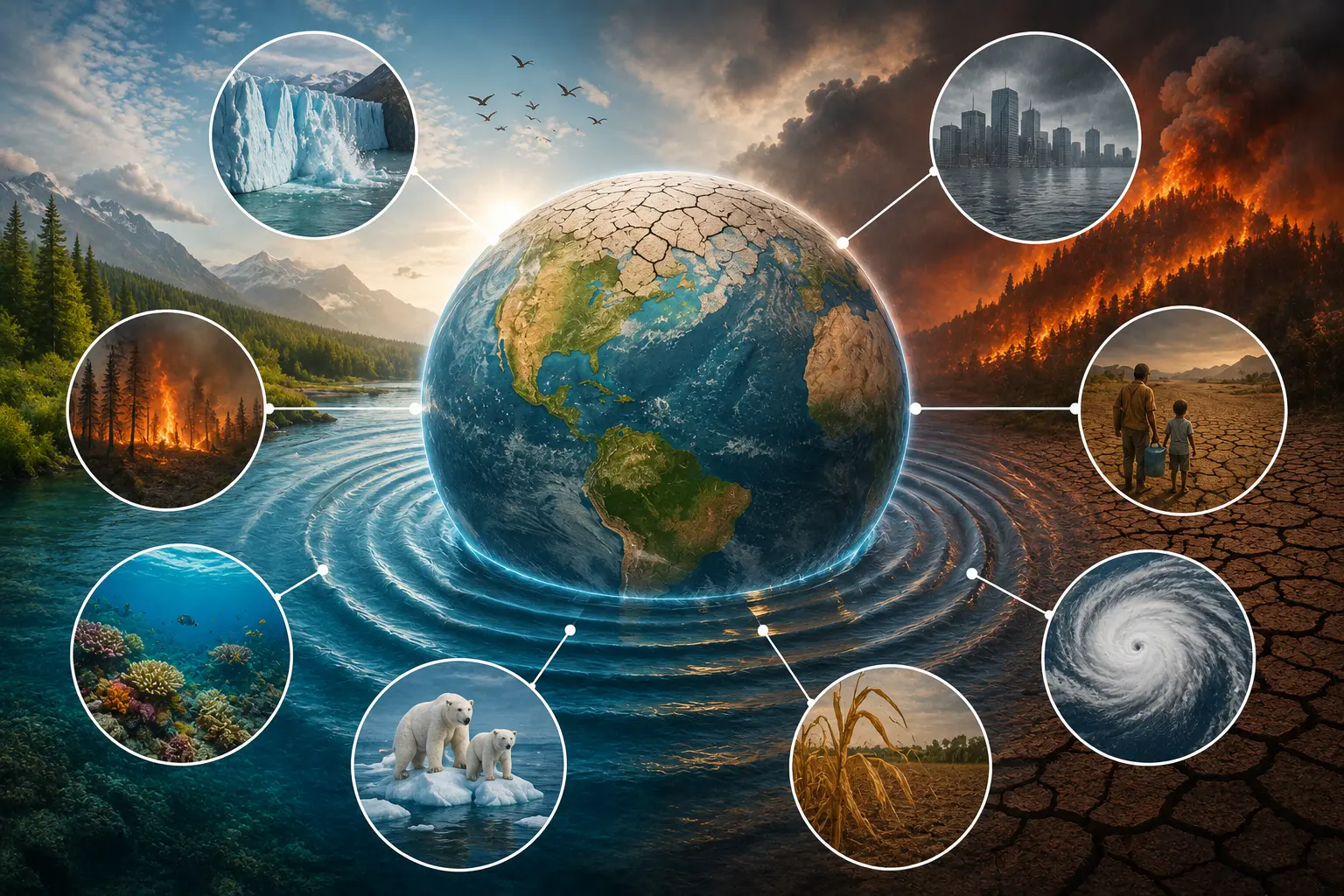
The ripple effects of climate change are no longer a distant warning. They are visible today in record-breaking heat, disappearing glaciers, collapsing coral reefs, and communities displaced by floods and wildfires. Every corner of the planet is feeling the pressure, and the pace of change is accelerating faster than most scientific models predicted even a decade ago. Understanding exactly what is happening, why it matters, and what can realistically be done is the first step toward meaningful action. This article walks through the most significant ways climate change is reshaping Earth, backed by data from leading scientific institutions, so you can see the full picture clearly.
The Far-Reaching Effects of Climate Change
The effects of climate change touch ecosystems, economies, health, and daily life across every continent.
Once you understand these impacts, the next step is making the business case for climate action inside your own organization.
The Ripple Effects Climate Change Starts With: Rising Global Temperatures
Everything begins with heat. According to NASA’s climate vital signs data, Earth’s average surface temperature has risen by approximately 1.1 degrees Celsius since the late 19th century. That number sounds small, but in planetary terms it is enormous. The energy required to warm the entire surface of the Earth by even a fraction of a degree is staggering, and that extra energy does not simply sit still. It drives stronger storms, shifts rainfall patterns, melts frozen water stores, and disrupts the biological rhythms that plants and animals have followed for thousands of years.
The primary driver of this warming is the buildup of greenhouse gases in the atmosphere, particularly carbon dioxide and methane released through burning fossil fuels, deforestation, and industrial agriculture. Carbon dioxide levels in the atmosphere have now surpassed 420 parts per million, a concentration not seen on Earth for at least 3 million years. The greenhouse effect itself is a natural and necessary process, but human activity has amplified it far beyond what the climate system can absorb without significant disruption.
The practical consequences of rising temperatures are already being felt. The ten hottest years on record have all occurred since 2010. Heatwaves that would have been considered once-in-fifty-year events are now happening every decade, and in some regions every few years. Agricultural zones are shifting northward and to higher elevations. Growing seasons are changing in ways that farmers have not had to adapt to before, and crop failures are becoming more frequent in regions that once had reliable harvests.
Melting Ice Caps and the Threat of Rising Seas
The Arctic is warming roughly four times faster than the global average. This is not a projection. It is a measured reality confirmed by decades of satellite data and on-the-ground observation. The consequences of that accelerated warming are playing out in real time. Arctic sea ice extent has declined by more than 13 percent per decade since satellite records began in 1979. The Greenland ice sheet is losing mass at a rate of roughly 280 billion tons per year. Antarctica is contributing additional billions of tons of meltwater to the ocean annually.
Global sea levels have risen by about 20 centimeters since 1880, and the rate of rise is accelerating. The current rate is approximately 3.7 millimeters per year, more than double the average rate of the 20th century. For low-lying coastal nations like the Maldives, Tuvalu, and Kiribati, this is not an abstract statistic. It is an existential threat. Parts of Bangladesh, home to tens of millions of people, face regular inundation. Major coastal cities including Miami, Jakarta, Mumbai, and Shanghai are investing billions of dollars in flood defenses that may ultimately prove insufficient if emissions are not dramatically reduced.
Beyond the human cost, melting ice disrupts ecosystems that have evolved around frozen conditions. Polar bears depend on sea ice as a platform for hunting seals. Walruses use ice floes as resting grounds. Arctic foxes, certain seal species, and numerous seabirds are all facing habitat loss that no amount of behavioral adaptation can fully compensate for. The loss of reflective ice also creates a dangerous feedback loop: as white ice is replaced by darker open ocean, the ocean absorbs more solar energy, which accelerates warming further.
How the Ripple Effects Climate Disruption Creates Destroy Ecosystems
Ecosystems are built on relationships. Plants, animals, insects, fungi, and microorganisms have co-evolved over millions of years into finely tuned networks where each species depends on others for food, pollination, seed dispersal, and habitat. Climate change is disrupting those relationships faster than most species can adapt, and the consequences are cascading through food webs in ways that are difficult to fully predict.
Coral reefs are among the most visible casualties. Often called the rainforests of the sea, coral reefs cover less than one percent of the ocean floor but support roughly 25 percent of all marine species. When ocean temperatures rise even one or two degrees above the seasonal maximum for an extended period, corals expel the symbiotic algae living in their tissues, turning white in a process called bleaching. Bleached corals are not dead, but they are severely stressed and highly vulnerable. Repeated bleaching events, which are now occurring with far greater frequency due to warming oceans, kill corals outright. The Great Barrier Reef has experienced mass bleaching events in 2016, 2017, 2020, 2022, and 2024, a frequency that gives the reef almost no time to recover between events.
On land, the disruption is equally serious. Migratory birds are arriving at breeding grounds before the insects they depend on for food have hatched, a mismatch driven by warming springs. Wildflowers are blooming earlier than the pollinators that evolved to visit them are active. Forests in the western United States and Canada are experiencing bark beetle outbreaks of unprecedented scale because warmer winters no longer kill enough beetles to keep populations in check. The resulting dead trees fuel catastrophic wildfires, which release stored carbon into the atmosphere, which drives further warming. These feedback loops are one of the most alarming aspects of the current climate crisis.
Extreme Weather Events and the Ripple Effects Climate Instability Produces
A warmer atmosphere holds more moisture. For every degree Celsius of warming, the atmosphere can hold roughly seven percent more water vapor. That extra moisture has to go somewhere, and it does, in the form of heavier rainfall events, more intense hurricanes, and more destructive flooding. At the same time, regions that are already dry are experiencing more intense and prolonged droughts as higher temperatures increase evaporation from soil and vegetation.
The statistics on extreme weather are striking. The number of weather-related disasters recorded globally has increased by a factor of five over the past 50 years, according to the World Meteorological Organization. Economic losses from these events have increased sevenfold over the same period. Hurricanes are intensifying more rapidly than they did in previous decades, and the proportion of storms reaching Category 4 or 5 intensity is increasing. Atmospheric rivers, the long bands of concentrated moisture that can deliver enormous amounts of rain in a short time, are becoming more intense and are causing flooding in regions unaccustomed to such events.
Wildfires deserve special attention. The area burned by wildfires in the western United States has more than doubled since the 1980s. Australia’s 2019 to 2020 Black Summer fires burned more than 18 million hectares, killed or displaced an estimated 3 billion animals, and blanketed cities in smoke for months. Canada’s 2023 wildfire season was the most destructive in recorded history, burning more than 18 million hectares and forcing the evacuation of hundreds of thousands of people. These are not isolated incidents. They are part of a clear and worsening trend driven by hotter, drier conditions.
The Ripple Effects Climate Change Has on Human Health
Climate change is increasingly recognized as one of the greatest threats to human health in the 21st century. The pathways through which it harms people are numerous and interconnected. Direct heat exposure is the most immediate. Extreme heat kills more people in the United States each year than any other weather-related cause. Globally, heat-related mortality is rising sharply, particularly among the elderly, outdoor workers, and people in urban areas where the heat island effect amplifies already dangerous temperatures.
Vector-borne diseases are expanding their geographic range as warmer temperatures allow mosquitoes, ticks, and other disease carriers to survive in regions where they previously could not. Dengue fever, once largely confined to tropical regions, is now endemic in parts of southern Europe and is spreading northward. Lyme disease is appearing at higher latitudes and elevations in North America. Malaria transmission zones are shifting in Africa and Asia. The World Health Organization estimates that climate change will cause approximately 250,000 additional deaths per year between 2030 and 2050 from malaria, diarrhea, heat stress, and malnutrition alone.
Food and water security are also under serious threat. Droughts reduce crop yields and dry up freshwater sources. Flooding contaminates water supplies and destroys harvests. Changing precipitation patterns are making it harder for farmers to plan planting and harvesting cycles. The United Nations Food and Agriculture Organization projects that climate change could reduce global crop yields by up to 25 percent by 2050 without significant adaptation measures. For the roughly 800 million people who already face food insecurity, that projection represents a humanitarian catastrophe in the making.
Climate Change and Global Food Systems
The global food system is one of the most climate-sensitive systems on Earth, and it is also one of the largest contributors to greenhouse gas emissions, accounting for roughly one-third of total global emissions. This creates a troubling cycle: the way we produce food contributes to climate change, and climate change threatens our ability to produce food.
Staple crops like wheat, rice, and maize are highly sensitive to temperature and precipitation changes. Studies have found that for every degree of warming above current temperatures, global wheat yields could decline by roughly six percent and rice yields by about three percent. These are not marginal losses. Wheat and rice together provide more than 40 percent of the calories consumed by humans worldwide. Declines of this magnitude would drive up food prices, increase hunger, and destabilize economies in regions that are already fragile.
Fisheries are also under pressure. Ocean warming and acidification, caused by the absorption of excess carbon dioxide, are disrupting marine food webs. Fish populations are shifting toward the poles as tropical waters become too warm. Shellfish and other organisms that build calcium carbonate shells are struggling to do so in increasingly acidic water. For the more than 3 billion people who rely on seafood as a primary source of protein, these changes have direct and serious implications for nutrition and livelihoods.
Climate Migration and Social Instability
As conditions become unlivable in certain regions, people move. Climate migration is already happening at significant scale, and projections suggest it will intensify dramatically in the coming decades. The World Bank estimates that without strong climate action, more than 216 million people could be forced to migrate within their own countries by 2050 due to slow-onset climate impacts including water scarcity, crop failure, sea level rise, and extreme heat.
This movement of people creates enormous social and political pressure. Host communities and countries face strain on housing, infrastructure, and public services. Competition for resources in climate-stressed regions can fuel conflict. The Syrian civil war, which began in 2011, was preceded by a severe multi-year drought that drove rural populations into cities and contributed to social unrest. Researchers have documented links between climate variability and conflict risk in multiple regions of the world, particularly in sub-Saharan Africa and South Asia.
The communities most vulnerable to climate-driven displacement are typically those that have contributed least to the problem. Small island nations, subsistence farming communities in the Global South, and indigenous peoples whose cultures and livelihoods are tied to specific landscapes face the greatest disruption. This profound injustice is at the heart of international climate negotiations and is one of the most morally urgent dimensions of the climate crisis.
What Science and Policy Say About Solutions
The science is clear that the severity of future climate impacts depends directly on how quickly and deeply humanity reduces greenhouse gas emissions. The Intergovernmental Panel on Climate Change has concluded that limiting warming to 1.5 degrees Celsius above pre-industrial levels, compared to the 2 degrees or more we are currently on track for, would significantly reduce the risks of the most catastrophic outcomes. That goal requires reaching net-zero carbon dioxide emissions globally by around 2050 and cutting emissions roughly in half by 2030.
The good news is that the tools to achieve this exist. Renewable energy from solar and wind is now the cheapest source of new electricity generation in most of the world. Electric vehicles are rapidly becoming cost-competitive with internal combustion engines. Energy efficiency improvements in buildings, industry, and transportation can reduce emissions substantially while also lowering costs. Protecting and restoring forests, wetlands, and other natural carbon sinks can remove significant amounts of carbon from the atmosphere while also supporting biodiversity and water security.
Policy frameworks matter enormously. Carbon pricing, clean energy standards, building codes, and land use regulations can accelerate the transition to a low-carbon economy. International agreements like the Paris Agreement, while imperfect, provide a framework for coordinated global action. You can explore the current state of international climate commitments through the United Nations Framework Convention on Climate Change. National governments, cities, businesses, and individuals all have roles to play, and the actions taken in this decade will determine the trajectory of the climate for centuries to come.
How Individuals and Communities Can Respond
Individual action matters, both for its direct impact and for the cultural and political signals it sends. Reducing personal carbon footprints through choices about diet, transportation, home energy use, and consumption is meaningful. A plant-rich diet, for example, can reduce an individual’s food-related carbon footprint by up to 50 percent. Choosing to fly less, drive an electric or hybrid vehicle, and invest in home insulation and efficient appliances all contribute to lower emissions.
Community-level action is often where the most powerful changes happen. Local governments can adopt ambitious climate action plans, invest in public transit, update building codes, and protect urban green spaces that reduce heat and manage stormwater. Community solar programs, neighborhood composting initiatives, and local food systems all reduce emissions while building resilience and social cohesion. Supporting businesses and organizations that prioritize sustainability sends market signals that accelerate the broader transition.
Civic engagement is perhaps the most powerful lever available to individuals. Voting for candidates who support strong climate policy, contacting elected representatives, participating in public comment processes, and supporting advocacy organizations amplifies individual impact far beyond what personal consumption choices alone can achieve. The U.S. Environmental Protection Agency offers practical guidance on both personal and community-level climate action that is worth exploring.
A Shared Responsibility for a Livable Future
The ripple effects climate change sets in motion do not respect borders, income levels, or political affiliations. A warming planet affects everyone, though it affects some far more severely and far sooner than others. Addressing this crisis requires a level of global cooperation that humanity has rarely achieved, but the stakes make it necessary. The science is unambiguous, the technologies are available, and the economic case for action is stronger than the case for inaction by virtually every serious analysis.
What is needed now is the political will, the social momentum, and the sustained commitment to translate knowledge into action at every level of society. Businesses have a critical role in decarbonizing supply chains, investing in clean innovation, and reporting transparently on their climate impacts. Sustainability marketing, done honestly and rigorously, helps consumers and investors make informed choices and rewards companies that are genuinely leading on climate. At Planet Media LLC, we believe that clear, accurate, and compelling communication about climate is one of the most important contributions a marketing agency can make to a livable future.
The window for avoiding the worst outcomes is still open, but it is narrowing. Every fraction of a degree of warming avoided matters. Every ecosystem protected matters. Every community made more resilient matters. The ripple effects climate change creates are real and growing, but so is the capacity of human ingenuity, cooperation, and determination to meet this challenge. The question is not whether we can. The question is whether we will choose to act with the urgency the moment demands.
Frequently Asked Questions
What are the ripple effects of climate change on global ecosystems?
The ripple effects climate change produces on ecosystems include coral reef bleaching, disrupted migration and breeding cycles, bark beetle outbreaks, and widespread biodiversity loss. These changes cascade through food webs, weakening the natural systems that support both wildlife and human populations. Species that cannot adapt quickly enough face local extinction, which further destabilizes the ecosystems they were part of.How much have global temperatures risen due to climate change?
According to NASA, Earth’s average surface temperature has risen by approximately 1.1 degrees Celsius since the late 19th century. This warming is primarily driven by the buildup of carbon dioxide and other greenhouse gases from burning fossil fuels, deforestation, and industrial agriculture. The ten hottest years on record have all occurred since 2010, confirming that warming is accelerating rather than slowing.How does climate change cause sea levels to rise?
Climate change causes sea levels to rise through two main processes: the melting of glaciers and polar ice sheets, and the thermal expansion of seawater as it warms. Global sea levels have risen by about 20 centimeters since 1880, and the current rate of rise is approximately 3.7 millimeters per year, more than double the 20th-century average. Low-lying coastal nations and major port cities face increasing flood risk as this trend continues.What are the ripple effects climate change has on human health?
The ripple effects climate change has on human health include increased heat-related illness and death, the geographic expansion of vector-borne diseases like dengue and Lyme disease, and growing food and water insecurity. The World Health Organization estimates that climate change will cause approximately 250,000 additional deaths per year between 2030 and 2050. Vulnerable populations including the elderly, outdoor workers, and people in low-income countries face the greatest risks.How does climate change affect food production?
Climate change threatens food production by altering rainfall patterns, increasing the frequency of droughts and floods, and raising temperatures beyond the tolerance of major staple crops. Research suggests that for every degree of warming above current levels, global wheat yields could decline by roughly six percent. The United Nations Food and Agriculture Organization projects that climate change could reduce global crop yields by up to 25 percent by 2050 without significant adaptation.What is the connection between climate change and extreme weather events?
A warmer atmosphere holds more moisture, which intensifies rainfall events, hurricanes, and flooding. At the same time, higher temperatures increase evaporation, making droughts more severe in already dry regions. The World Meteorological Organization reports that the number of weather-related disasters has increased fivefold over the past 50 years, with economic losses increasing sevenfold over the same period.How many people could be displaced by climate change by 2050?
The World Bank estimates that more than 216 million people could be forced to migrate within their own countries by 2050 due to climate impacts including water scarcity, crop failure, sea level rise, and extreme heat. This internal climate migration will place enormous pressure on host communities and urban infrastructure. The populations most at risk are typically those in low-income countries that have contributed least to global greenhouse gas emissions.What can individuals do to reduce the ripple effects of climate change?
Individuals can reduce the ripple effects climate change creates by lowering their personal carbon footprint through diet choices, transportation decisions, and home energy use. A plant-rich diet can cut food-related emissions by up to 50 percent, and switching to electric vehicles or public transit significantly reduces transport emissions. Civic engagement, including voting for climate-supportive candidates and contacting elected officials, amplifies individual impact far beyond personal consumption choices alone.What is the scientific consensus on limiting climate change to 1.5 degrees Celsius?
The Intergovernmental Panel on Climate Change has concluded that limiting warming to 1.5 degrees Celsius above pre-industrial levels would significantly reduce the risks of the most catastrophic climate outcomes compared to 2 degrees or more of warming. Achieving this goal requires reaching net-zero carbon dioxide emissions globally by around 2050 and cutting emissions roughly in half by 2030. The technologies needed to reach this target already exist, and the economic case for action is stronger than the case for inaction.Why are coral reefs particularly vulnerable to climate change?
Coral reefs are highly sensitive to ocean temperature because corals expel the symbiotic algae in their tissues when water temperatures rise even one or two degrees above seasonal norms, causing bleaching and potential death. The Great Barrier Reef has experienced mass bleaching events in 2016, 2017, 2020, 2022, and 2024, leaving almost no recovery time between events. Because coral reefs support roughly 25 percent of all marine species despite covering less than one percent of the ocean floor, their decline has enormous consequences for ocean biodiversity and the billions of people who depend on marine fisheries.Related Articles
- Climate Change: How Will it Affect our Food Supply in the Next Decade
- The Growing Reality of Drought in Colorado and the American West
- How Do We Help Mitigate Climate Change?
- Unraveling the Climate Change Hoax Belief: Understanding the Skepticism
- How Significant is the Impact of Climate Change?
Turning your mission into a brand people trust? See how Planet Media approaches sustainable branding for purpose-driven organizations.

Kurt Whitt
Planet Media
Founder and CEO of Planet Media, a sustainability focused marketing agency. 25+ years helping purpose driven brands grow through strategy, storytelling and design.
More about the team